
START WITH WHAT YOU KNOW.
Begin with a short HOS assessment to see
where you stand.
Hours of Service doesn't happen in a classroom.
It happens when the clock is running. When a shipper keeps you waiting. When
the schedule changes. When dispatch needs an answer. When your ELD shows
available time, but the situation isn't as simple as the screen makes it look.
HOSoptima training is built for those moments.
Learn the rules. Work through practical situations. Strengthen your understanding.
Then demonstrate what you know.
Not sure where your HOS knowledge stands? Take the Free HOS Assessment →
For commercial drivers, owner-operators, fleets, training organizations and others responsible for HOS
knowledge and education.
Built Specifically for HOS
Focused on Hours of Service.
Scenario-Based Learning
Put HOS concepts into practical
context.
Knowledge Checks
Reinforce understanding as you learn.
Path to Certification
Demonstrate what you've learned.
A driver can finish a course without fully understanding what was taught. That's a problem when the subject is Hours of Service.
HOS decisions happen throughout a driver's day, and the answer isn't always sitting neatly on a screen.
HOSoptima is designed to move drivers beyond simply being exposed to HOS information.
The goal isn't simply to finish HOS training. It's to understand what you're doing when the situation changes.
Understand what happens when
multiple rules and clocks interact.
Build a strong understanding of
the rules, limits, responsibilities.
Use that knowledge to work
through practical HOS situations.
Identify situations that may create
compliance problems before
making the next move.
Demonstrate you've learned
through assessment and
certification.
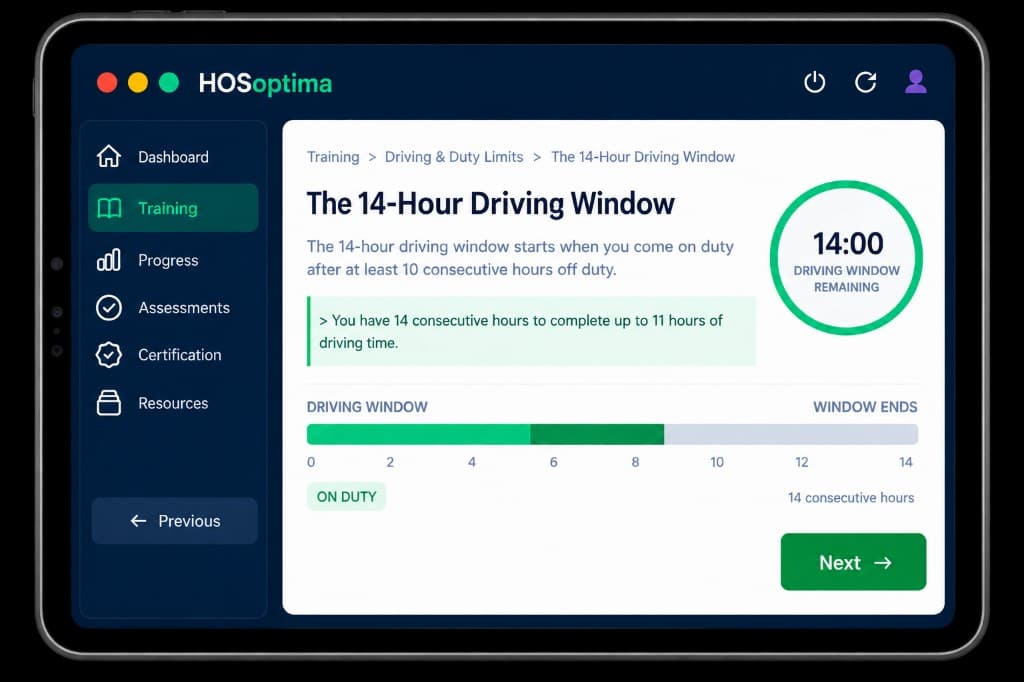
Hours of Service is easier to understand when concepts are introduced in the right order.
HOSoptima training builds from foundational HOS concepts into situations that require drivers to connect multiple
pieces of information and decide what matters.
Key rules, terminology and
driver responsibilities.
Driving limits, duty
windows, breaks and
available hours.
How accumulated on-duty
time affects your available
hours.
How sleeper-berth use
works and why it matters.
When an exception may
apply and what the
requirements are.
The relationship between
HOS rules, records and
ELDs.
Bring it all together with
practical situations.
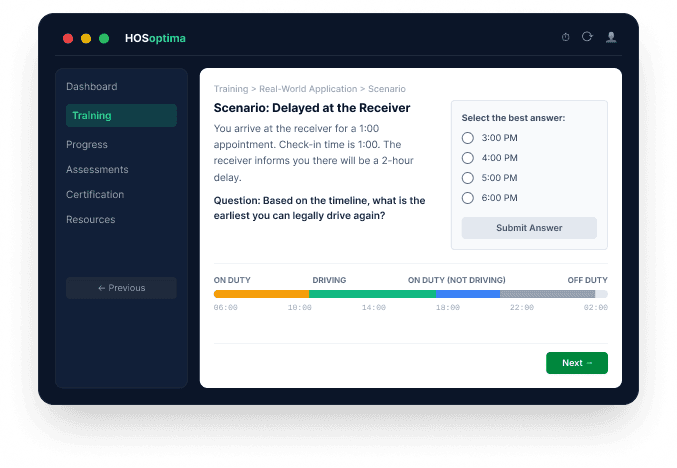
A driver's day doesn't stop and announce: “This is a 14-hour driving-window question.”
A delay happens. Plans change. Time keeps moving. And the driver still has to decide
what happens next.
Knowing a rule matters. Knowing when and how it applies is where understanding becomes useful.
Build understanding through
structured HOS instruction.
Work through examples and
scenarios that put HOS concepts
into context.
Use knowledge checks to
reinforce what you've learned.
Return to concepts where
additional attention may help.
Complete the applicable
assessment requirements and
demonstrate your HOS knowledge.
Meet the HOSoptima program
requirements and earn HOSoptima
certification.
HOSoptima isn't designed around hours of passive
clicking. The training experience combines instruction,
examples, practical situations and knowledge checks so
drivers stay engaged with the decisions behind Hours of
Service.
Begin with a short HOS assessment to see
where you stand.
Strengthen your
understanding of the rules
and concepts that affect your
working day.
Build the HOS knowledge
behind decisions that directly
affect your own operation.
Give your drivers structured
HOS education built around
understanding and
application.
Provide members with access
to focused Hours of Service
education.
FOR FLEETS & ORGANIZATIONS
Establish a baseline of HOS knowledge across a sample of
your drivers and see what the results reveal.
ONE QUESTION REMAINS: